Protect Haleakalā Community Collective | September 29, 2026
On most things, Maui residents and the U.S. military see AMOS STAR very differently. On one point, the public record shows them in agreement: fixed military infrastructure on the ground is a target.
Residents said so at the Department of the Air Force’s public hearings on the AMOS STAR Draft Environmental Impact Statement in Kīhei on February 17 and Pukalani on February 18, 2026, less than two weeks before the United States went to war with Iran. U.S. Space Command says so in The Space Warfighting Environment 2040, published in July 2026. And the war with Iran has shown what that looks like in practice.
Recent targeting facts
Space Command’s own document uses Iran as its warning. It opens the example with a clear statement of how Iran fights:
“Unlike previous conflicts in Iraq, Afghanistan, or Libya, Iran deliberately targets U.S. space-enabling infrastructure from the opening phases of conflict.” (p. 12)
It then points to a specific attack:
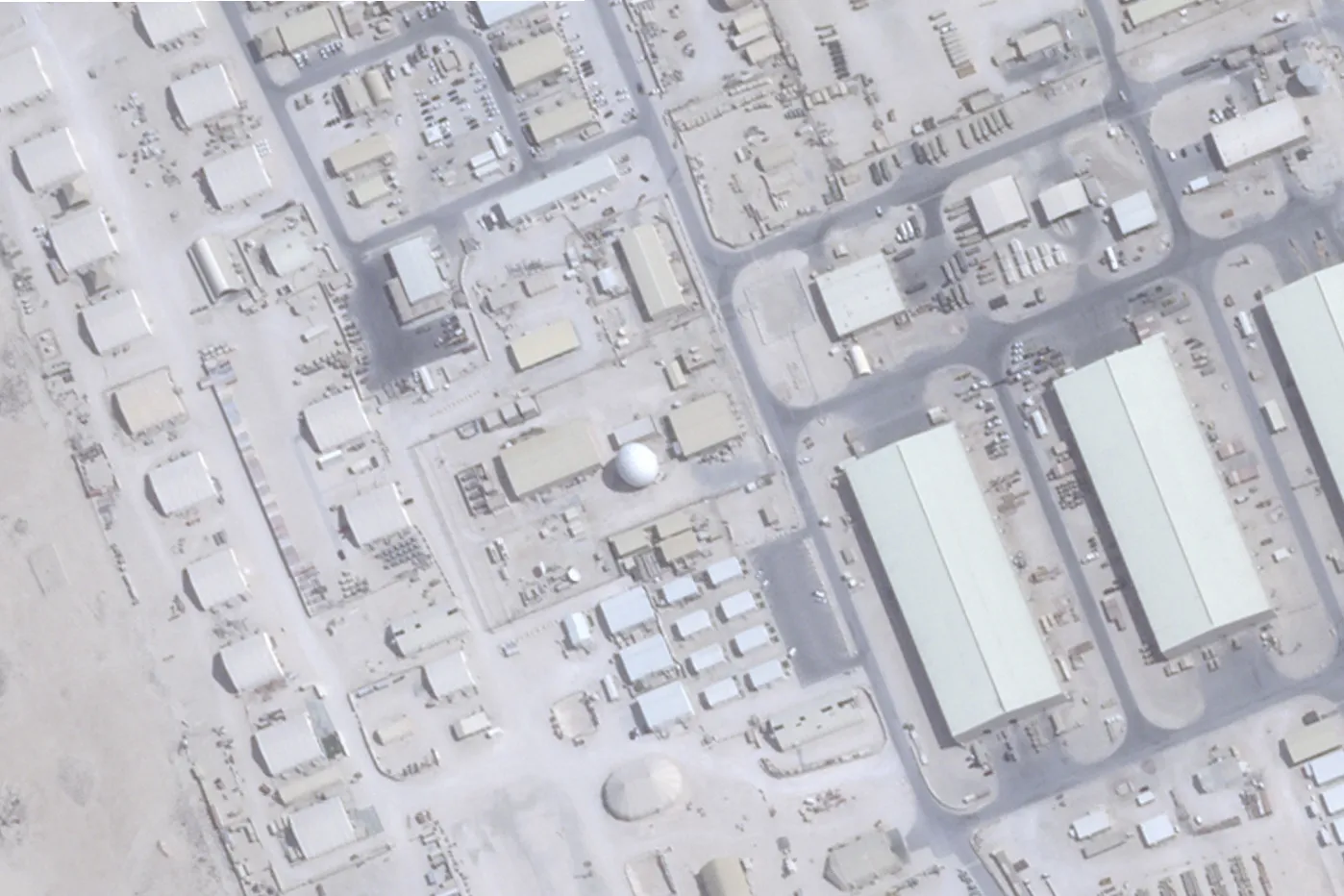
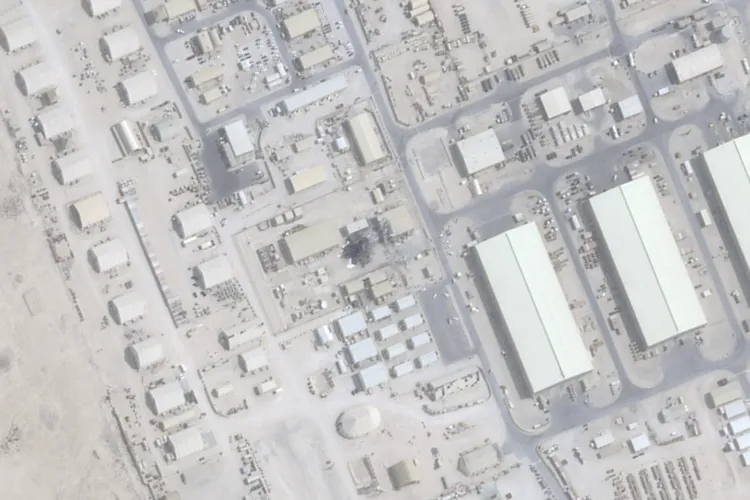
“In 2025, Iran’s strike against the Modernized Enterprise Terminal radome at Al Udeid Air Base in Qatar reinforced this reality. Rather than broadly attacking the installation, Iran targeted infrastructure supporting U.S. communications and space-enabled operations, demonstrating an understanding of the critical nodes underpinning Joint Force power.” (p. 12)
That attack is visible from space. Commercial satellite photos from Planet Labs showed the radome standing on the morning of June 23, 2025, the day Iran retaliated; from June 25 onward, the dome was gone, with burn marks and damage to a neighboring building. After the Associated Press published its analysis of the imagery, a Pentagon spokesperson acknowledged within hours that an Iranian ballistic missile had hit the dome. Space Command printed a photo of that same radome in its report, captioned as it looked “before destruction.” (p. 12)
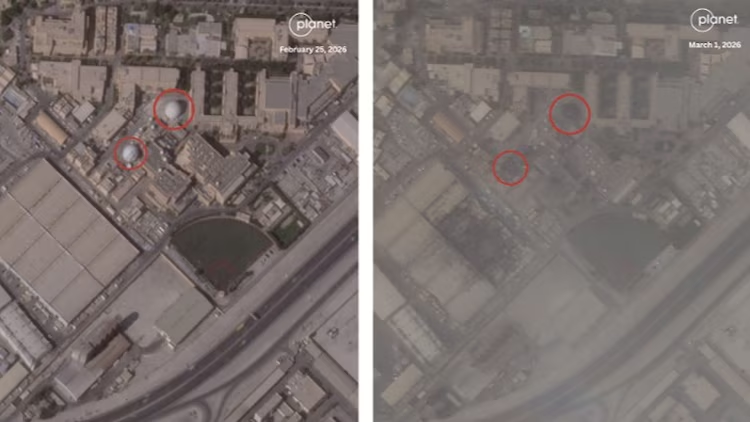
Then came 2026. The U.S. military launched Operation Epic Fury against Iran on February 28, 2026. Space Command’s report says that during Epic Fury, Iranian forces targeted “radar systems, communication nodes, missile warning architecture, and other fixed infrastructure supporting U.S. operations.” (p. 12) Independent satellite analysis confirms it. According to ABC News, imagery shows Iran and its proxies went after radar systems in at least seven Middle Eastern countries in the early days of the war, damaging several AN/TPY-2 radars that support THAAD missile defense, plus a large early-warning radar in Qatar. CNN reported that the radar for an American THAAD battery in Jordan was hit and apparently destroyed in the first days of the U.S.-Israeli strikes, with satellite imagery from March 2 showing debris around the blackened radar.
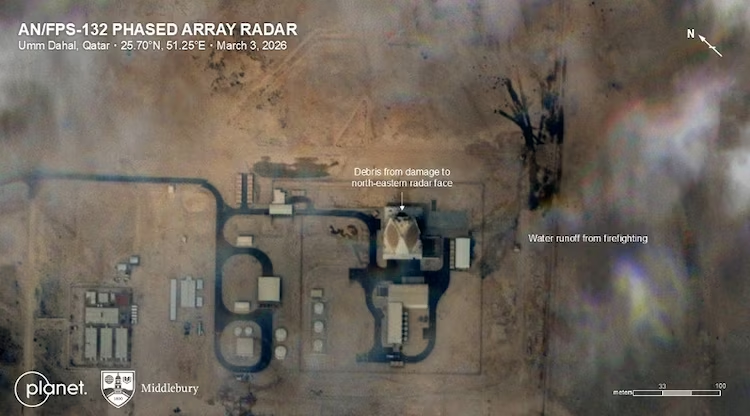
This is not history. At the start of September, Iran’s president said his country was ready to return to the June ceasefire if Washington did the same, after the two countries traded fire for the first time in a month.
What Space Command concludes
From these examples, Space Command draws a general lesson about ground sites:
“Future adversaries will increasingly surveil, characterize, and target fixed infrastructure long before conflict formally begins.” (p. 13)
“Static ground nodes, once the norm, will become liabilities. They represent single points of failure that adversaries can attack through cyber intrusion, directed energy, precision fires, or sabotage. In a future where space effects must persist through the first strike, fixed infrastructure will be targeted early and often.” (p. 27)
Defense press read the document the same way. Breaking Defense headlined its coverage with Space Command preparing for attacks on ground segments.
AMOS is not a radar or a satellite communications terminal. It is an optical space surveillance site. But Space Command’s warning is not limited to one type of equipment. It describes fixed ground infrastructure as a category, and AMOS is fixed ground infrastructure on the summit of Haleakalā, above Kula, Pukalani, Makawao, and Kīhei.
What Maui residents and officials said
At the February 2026 hearings, at least eight testifiers raised this concern directly, four at each hearing:
| Testifier | Hearing | What they said |
|---|---|---|
| Keani Rawlins-Fernandez, Maui County Council (Molokaʻi) | Kīhei | “Finally, your presence threatens our security. [You] make our islands a target, just as your presence at Pearl Harbor did in 1941.” |
| Lucienne de Naie, Sierra Club Maui Group | Kīhei | “And the future militarization of Hawaiʻi, who wants that? We don’t need to be a target.” |
| Richard Ho | Kīhei | “Every time you guys build one base, every time you guys play Star Wars, you guys put one target on our back.” |
| Testifier #2 (name not stated) | Kīhei | “So in whose defense are we caring for? Yours or ours? Because you make us a target where we were not before.” |
| Trinette Furtado | Pukalani | “No matter how much you want to paint that your presence here keeps other entities away, it only makes it more dangerous for us. It only makes us more of a target.” |
| Carolee Kapikona | Pukalani | “The continued illegal occupation puts a target on our backs by countries who despise what the U.S. stands for.” |
| Testifier #35 (name not stated) | Pukalani | “The continued militarization of ʻāina here in illegally occupied Hawaiʻi does not protect our communities. It puts a target on our backs.” |
| Testifier #37 (name not stated) | Pukalani | “Your very presence continues to and has made us targets.” |
A different view
Not everyone at the hearings agreed. In Pukalani, testifier Jamie Chapman, who said he spent more than two decades assessing foreign nuclear weapons, argued that AMOS STAR helps protect Hawaiʻi by supporting the identification of incoming missile threats.
That argument deserves an answer in the record, and so do the residents’ concerns. Both point to the same question: what does this project mean for the safety of the people who live below it?
What happens next: the MOA
The next decision point is a Memorandum of Agreement under Section 106 of the National Historic Preservation Act. Its signatories are the U.S. Space Force’s Space Base Delta 1, the Advisory Council on Historic Preservation, and the Hawaiʻi State Historic Preservation Officer. The latest draft reviewed by the Collective is dated August 20, 2026.
The draft states that signing it “is evidence that SBD 1/MSSC has taken into account the effects of the Undertaking on historic properties.” Maui has told the military, in public testimony and in the Council’s unanimous resolution, that those effects have not been accounted for. A signature would say otherwise.
Protect Haleakalā. Do not sign the MOA.
Sources
- U.S. Space Command, The Space Warfighting Environment 2040 (2026 release), pp. 12, 13, 27.
- U.S. Space Command, “USSPACECOM releases Space Warfighting Environment 2040…”, July 27, 2026.
- Breaking Defense, “Space war 2040: SPACECOM preps for attacks on ground segments, eyes cislunar ops”, August 2026.
- Associated Press (via The Hill), “Iran’s attack on Qatar air base hit geodesic dome used for US communications, satellite photos show”, July 11, 2025.
- Newsweek, “Satellite Images Show Damage From Iran Strike on US Air Base”, July 11, 2025.
- U.S. Department of Defense, “Operation Epic Fury”.
- ABC News, “US and allied radar sites in the Middle East struck at least 10 times: Visual analysis”, March 2026.
- CNN, “Radar bases housing key US missile interceptor hit in Jordan and UAE, satellite images show”, March 5, 2026.
- Fortune, “Iran says it’s ready to return to its ceasefire with the US”, September 1, 2026.
- Public testimony, AMOS STAR DEIS public hearings, Kīhei (February 17, 2026) and Pukalani (February 18, 2026).
- Draft Memorandum of Agreement, AMOS STAR Project at Maui Space Surveillance Complex, preliminary draft dated August 20, 2026.
Last updated: September 29, 2026.