Protect Haleakalā | September 26, 2026
The Department of the Air Force is close to finalizing a Memorandum of Agreement (MOA) with the State Historic Preservation Officer and the federal Advisory Council on Historic Preservation (ACHP). Once signed, it completes the federal historic preservation review for seven new Air Force telescopes on the summit of Haleakalā.
Here is what the agreement says, what it leaves out, and what you can do.
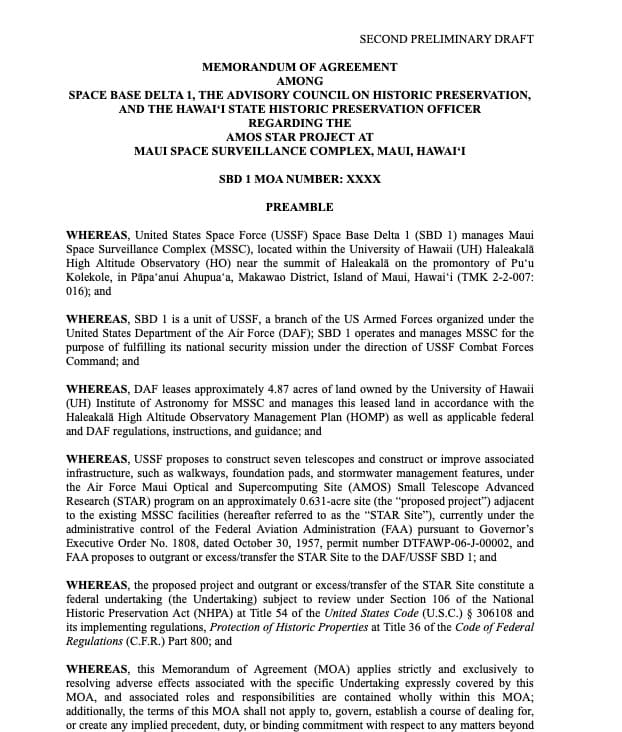
What is this agreement?
Under Section 106 of the National Historic Preservation Act, federal agencies must consider how their projects affect historic and cultural places. The Air Force has already found that this project will cause an adverse effect on the Haleakalā Summit Traditional Cultural Property.
When an adverse effect is found, the agency, the State Historic Preservation Officer and sometimes the ACHP negotiate an MOA setting out how the harm will be “resolved.” Signing it concludes the review.
Section 106 is a process law. It requires agencies to consult and to take effects into account. It does not give communities a veto. That is why an honest, complete record matters so much: the record is what the agencies are accountable to.
Who was invited?
The MOA states that Native Hawaiian Organizations (NHOs) were invited to consult on January 27, 2025 and January 19, 2026, that they are “listed in Appendix A,” and that none chose to take part.
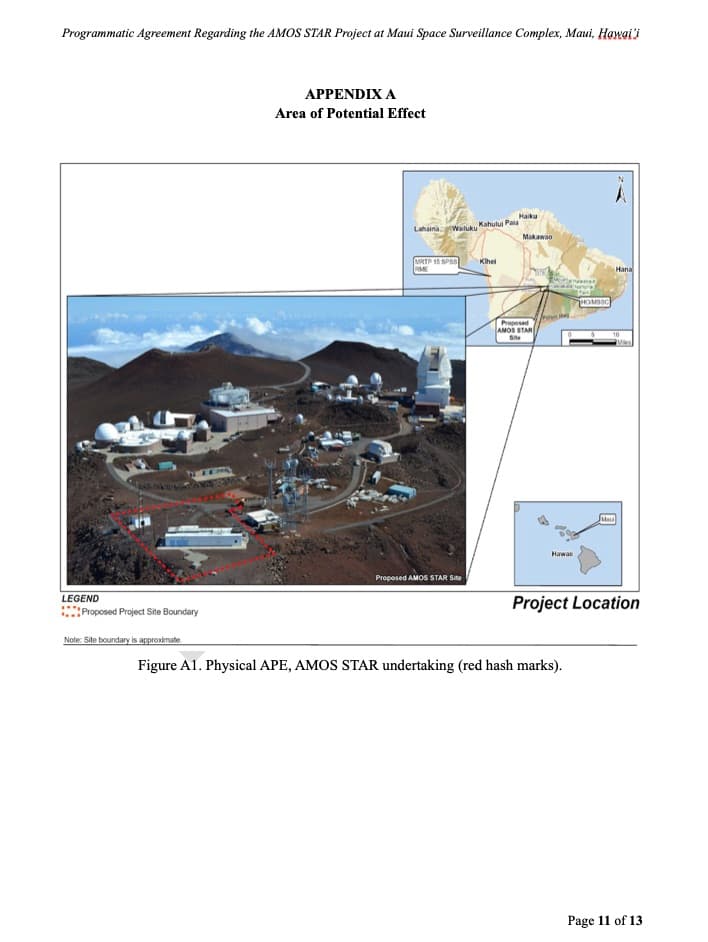
Appendix A contains no list.
It holds only maps. In every draft we have seen (April 23, June 3 and August 20, 2026), the list the agreement relies on is missing. Its pages are even headed “Programmatic Agreement,” a different type of document.
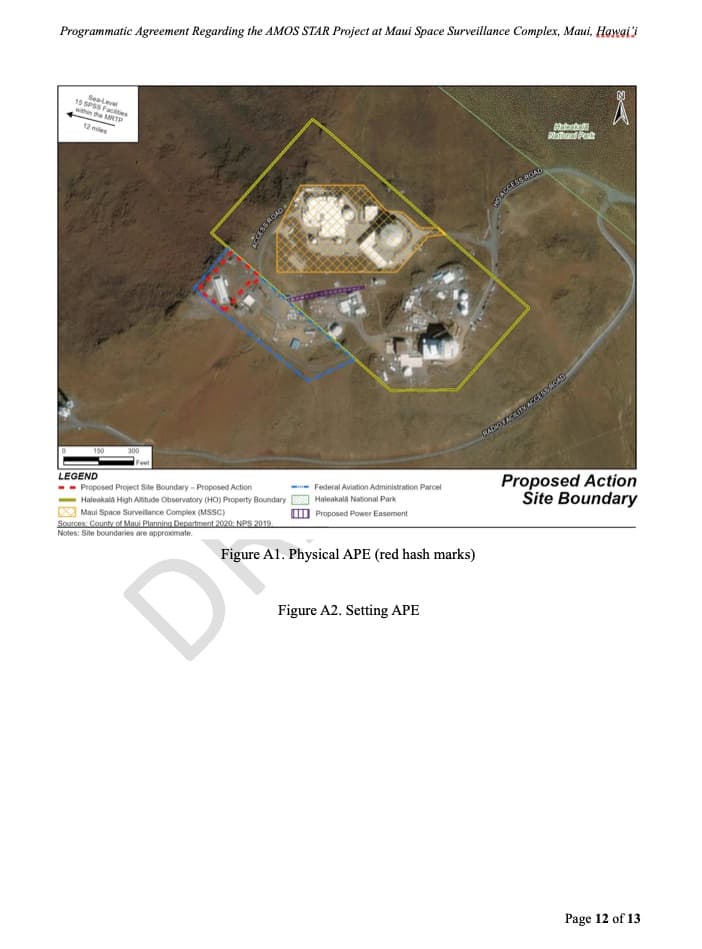
The dates raise their own question. The letters to NHOs published in the Air Force’s January 2026 Draft Environmental Impact Statement are dated January 27, 2026, not 2025.
A separate Air Force document lists dozens of organizations drawn from the Department of the Interior’s NHO notification list, including the Office of Hawaiian Affairs, Aha Moku O Maui, the Association of Hawaiian Civic Clubs and ʻĀina Momona. The same document describes biweekly meetings with NHOs since March 2023.
So which is it? Were these organizations formally invited to consult on this agreement? Did they decline, or did they never hear back? Silence is not the same as saying no.
If your organization is on the list, please tell us whether you were invited.
Where are our voices?
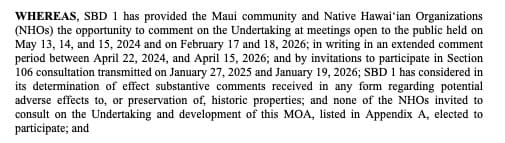
The MOA itself lists the opportunities the community had to speak: public meetings on May 13, 14 and 15, 2024 and February 17 and 18, 2026, and written comments between April 22, 2024 and April 15, 2026.
We used every one of them.
- →Scoping, 2024: about 89% of comments opposed the project.
- →Maui County Council, 2024: passed Resolution 24-103, opposing construction of AMOS STAR.
- →Kīhei and Pukalani, February 2026: dozens testified against the project, night after night. Watch Pukalani | Watch Kīhei
- →Kahului, 11 March 2026: community members questioned Air Force at a public Q&A 'Hanohano ʻO Haleakalā'. Recap
- →May 2026: OHA’s own newspaper, Ka Wai Ola, ran a cover story on the generations of kiaʻi pushing back against further development on Haleakalā.
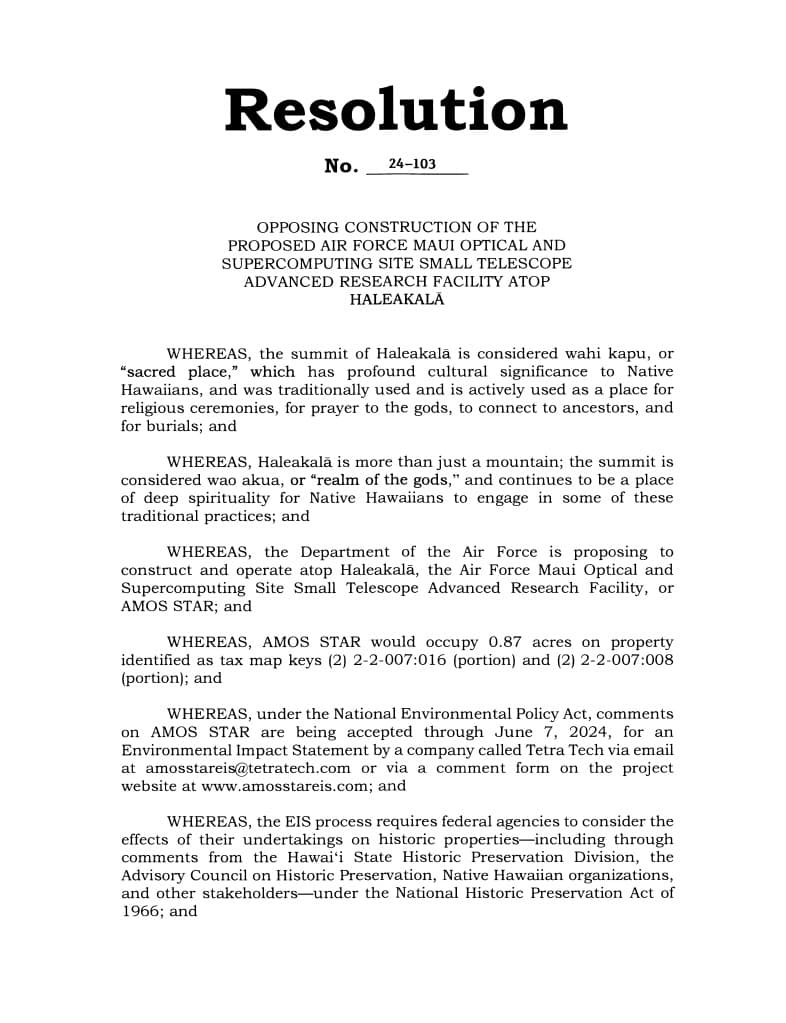
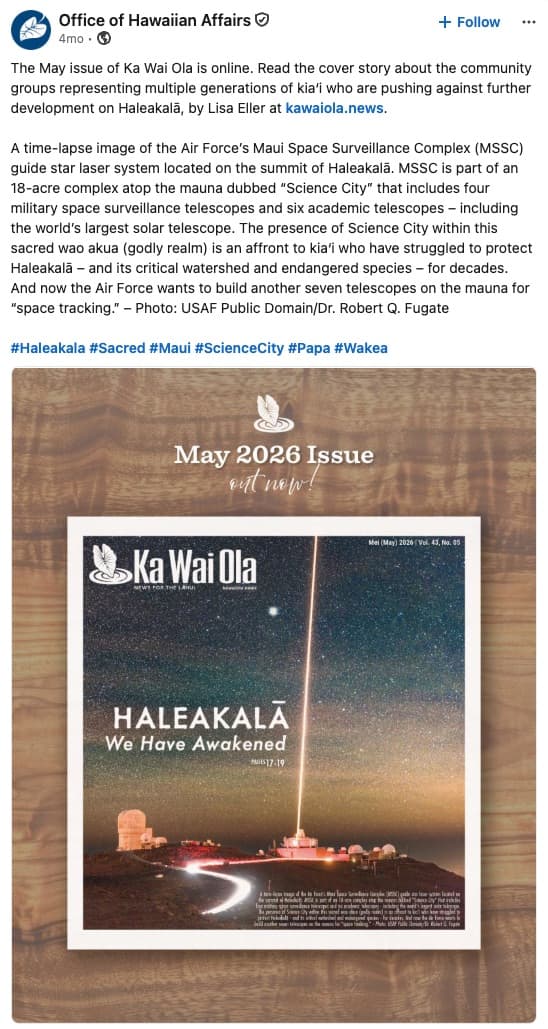
The MOA reduces all of it to a single line, stating that the Air Force “has considered in its determination of effect substantive comments received.”
The oversight agencies have raised this themselves
- →On February 7, 2025, the ACHP told the Air Force its submission lacked summaries of the views of the public and consulting parties.
- →On February 13, 2026, the ACHP confirmed to us in writing that it had received no response to that letter.
- →On February 18, 2026, SHPD asked the Air Force for more detailed documentation of public comments.
The records we obtained do not show that either agency’s request was met.
The timing also raises a question. SHPD received the Air Force’s finding of adverse effect on January 19, 2026, before the February hearings took place. We have asked the Air Force to explain how those comments were considered in a finding submitted before they were made.
Access is not mitigation
With no NHO at the table, the agreement’s “mitigation measures” were written without Hawaiian manaʻo. One of them is making sure practitioners can still reach Hinalaʻanui, the ceremonial ahu on Puʻu Kolekole.
Access to our own ahu is not mitigation. It is the most basic protection of our religious and spiritual practice. There is no mitigating the sacred.
Why we have not joined consultation
Many in our community, including us, face a real dilemma. Taking part in consultation risks being presented as acceptance of a project we oppose. Staying out is recorded only as “elected not to participate,” which hides the reason.
We have written to the Air Force, SHPD and the ACHP asking how they will record communities who refuse to consult as an act of protest, so that refusal is never mistaken for consent.
What we have done
- →February 13, 2026: The ACHP’s Office of Federal Agency Programs confirmed to us in writing that it had not received a response to its February 7, 2025 letter.
- →February 17 and 18, 2026: Community members testified against the project in Kīhei and Pukalani.
- →March 11, 2026: Community members organized the Hanohano ʻO Haleakalā event at UH Maui.
- →September 7, 2026: Wrote to SHPD with a UIPA requesting records pertaining to AMOS STAR and SHPD
- →September 25, 2026: Formally requested the list of invited NHOs, the invitations and responses, and the record of public testimony sent to the ACHP.
- →September 25, 2026: Asked the Air Force, SHPD and the ACHP, in writing, how protest non-participation will be recorded.
We will post their responses here.
What you can do
Community deserves fair representation. No sign the MOA.
1. Email the decision makers
Ryan Kanakaʻole, DLNR/BLNR Chair and State Historic Preservation Officer
dlnr@hawaii.gov | 808-587-0400
Jessica Puff, SHPD Administrator
jessica.puff@hawaii.gov | SHPD Project No. 2025PR00129
Advisory Council on Historic Preservation
achp@achp.gov | 202-517-0200 | ACHP Case No. 022091
Ask them: Do not sign the AMOS STAR Memorandum of Agreement until the list of invited Native Hawaiian Organizations is made public and the community’s testimony is part of the record.
Please add a sentence or two in your own words. Identical emails are easier to set aside.
2. Check the list
If you belong to a Native Hawaiian organization, check the list and tell us whether you were invited.
3. Share
Share this page and our carousel.
Share the carousel
This page will be updated as agencies respond. Last updated: September 26, 2026.