Coalition Update
Recap of Q&A at Hanohano ʻO Haleakalā
March 11, 2026 · UH Maui College
Date
Wednesday, March 11, 2026
Source
Protect Haleakalā Coalition
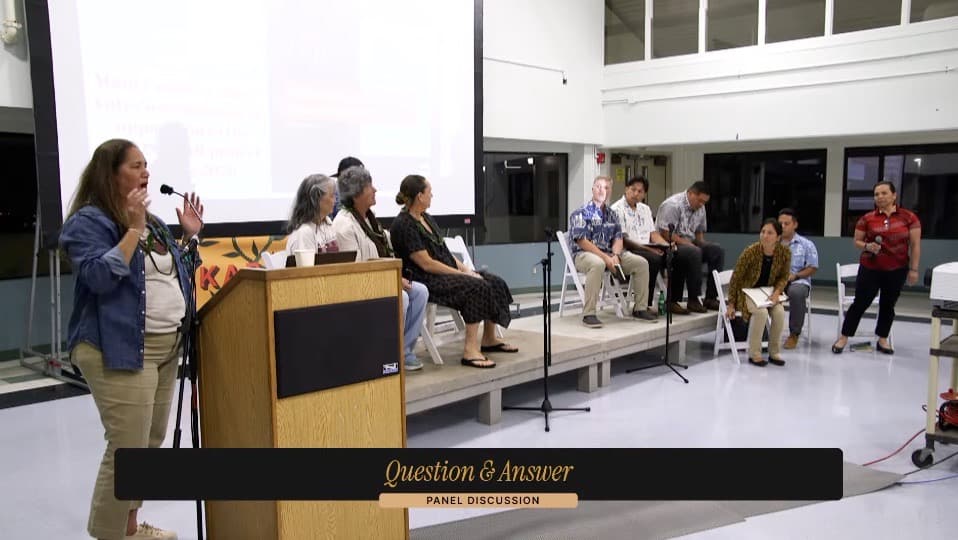
Last night the community invited the Air Force to the University of Hawaiʻi Maui campus to hear community manaʻo (thoughts).
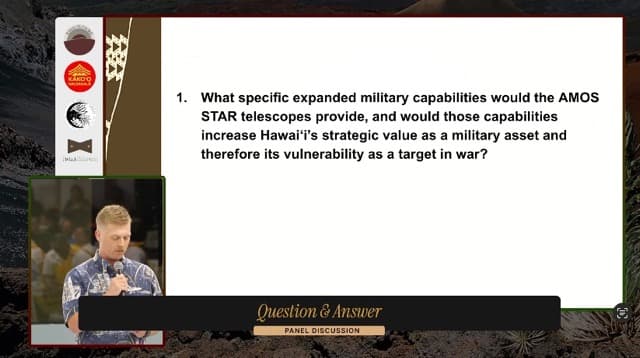
Tough questions were presented and answered — here's a quick recap of the questions asked and the slides with the questions.
📺 Watch the Full Livestream
Questions & Answers
What was discussed
The Air Force described their mission as "space domain awareness" — tracking and characterizing satellites and space objects, similar to how the FAA tracks aircraft. They stated the telescopes would provide testing and range safety for on-orbit satellites, sensors to detect adversaries hiding in orbit, daytime observation capability, laser communications, and a LiDAR tracking system. Community members pressed hard on whether this surveillance data could be used in military strikes against indigenous peoples worldwide, referencing Gaza. The military admitted they could not guarantee how the information would be used beyond their command chain. Panelists pointed out that surveillance sites in other countries are targeted in wartime precisely because of their tracking capability, undermining the claim that the mission does not increase Hawaiʻi’s vulnerability.
What was discussed
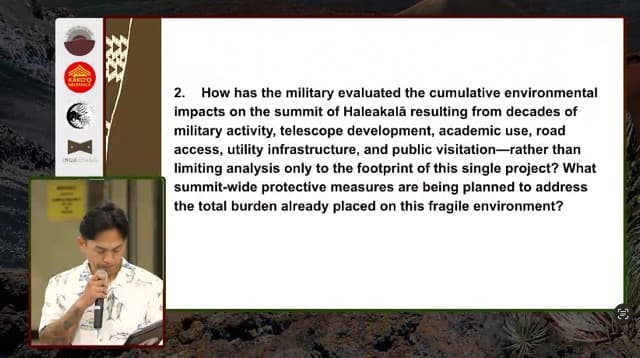
The Air Force referenced page 3-3 of the Draft EIS and a "combined effects" section (3.1.4) that analyzes incremental impacts alongside past, present, and foreseeable future actions by multiple agencies. However, community panelists challenged this as insufficient — describing single paragraphs that simply state conclusions without rigorous analysis. The military admitted they don’t yet know the electrical load the seven new telescopes would require because they haven’t been designed. A community elder asked whether there is an expected lifespan for the telescopes. The moderator pointed out that the approach of projecting the maximum possible damage and scaling back is "really hard to hear" from the community’s perspective.
What was discussed
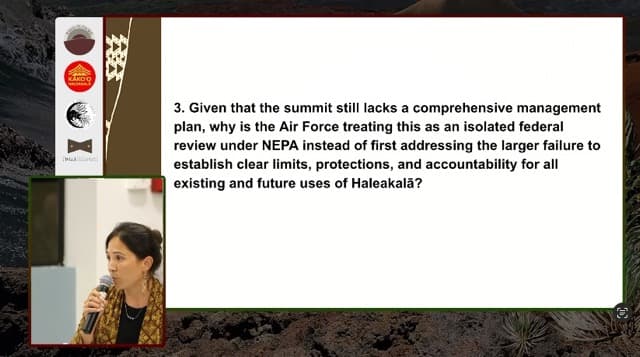
The Air Force acknowledged that creating a comprehensive summit management plan is "beyond the statutory authority of the Department of the Air Force" but expressed willingness to participate in one. Community panelists pointed out that the DEIS uses the already-built DKIST telescope as a baseline for measuring visual impact — comparing the new telescopes as "smaller than DKIST," which the community called disingenuous. A panelist compared it to an abusive relationship: "He knocked me out last week, so if he just slaps me tonight, it’s not gonna be a problem." The community expressed deep mistrust about co-creating a management plan with the military and suggested the summit deserves the highest protections, potentially extending the National Historic Register boundary.
What was discussed
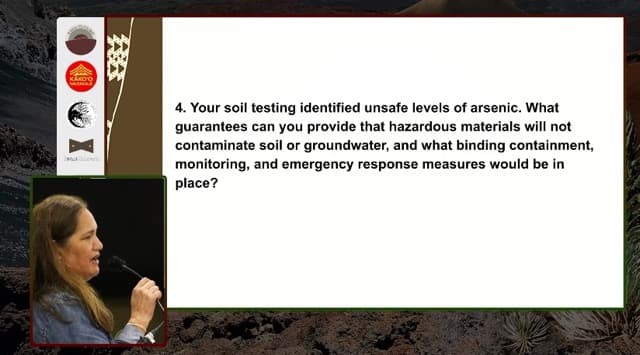
The Air Force acknowledged arsenic contamination documented in the DEIS (pages 3-47 to 3-50) and said their old plan as a "containment in place" strategy — burying contaminated soil under two feet of clean fill. Community panelists challenged this, noting it could push contaminants closer to the water table. Regarding the 2023 diesel fuel spill, the military revealed that a bio-venting remediation system wasn’t installed until July 2025 — a year and a half after the spill. "Air it out" is not a remediation strategy. The military admitted they don’t fully know the extent of toxic chemicals and couldn’t answer whether demolition waste from Building 1010 (the source of arsenic) would be taken off-island. When pressed about hazardous material disposal practices, an officer candidly said "I don’t know the entire answer to that."
What was discussed
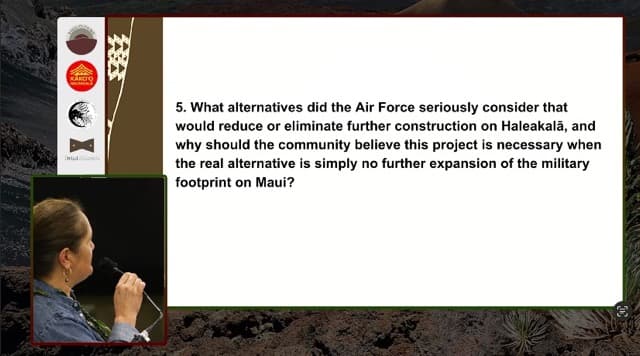
The community pressed hard for evidence of rigorous alternative site analysis, but the Air Force could not provide one. The commander began by explaining Haleakalā’s value — third-best nighttime viewing in the world — but the community moderator repeatedly redirected: "Don’t tell me about Haleakalā. Tell me about another place you have actually deeply considered." When asked about Chile, a civilian officer said it was "not accessible." The community pointed out that if these telescopes track near-Earth orbit objects (not deep space), they could potentially operate from many other locations. An engineer admitted that sites in the continental U.S. were considered during mission analysis but detailed analysis wasn’t in the EIS. The moderator concluded: "For the record, there are not detailed analyses of other sites at this current time."
What was discussed
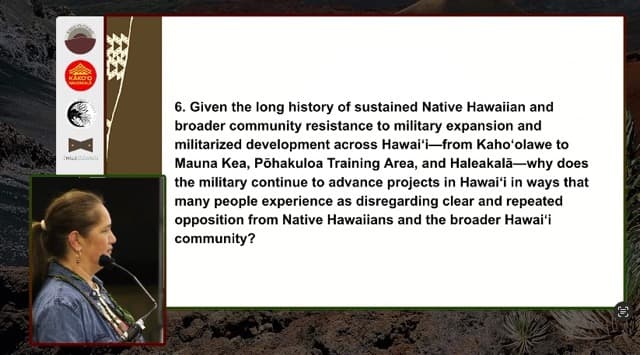
This question sparked the most emotionally charged exchange of the evening. The Hawaiʻi Coordination Cell representative said the military will continue to be in Hawaiʻi and that they are trying to improve processes. A community panelist directly asked: "Will Space Force move forward and desecrate Haleakalā without the express consent, free and informed, from Native Hawaiians?" The answer was: "I honestly don’t know." When asked whether Native Hawaiians are human beings deserving of human rights, the representative said "Yes" — but the panelist pressed that the military acts otherwise by disregarding repeated opposition. The representative said "I don’t think it’s binary." The community concluded that consultation, as practiced, amounts to the military doing what it wants regardless of opposition, and likened it to systemic denial of consent.
📝 Full Q&A Transcript
Read the complete raw transcript of the Question & Answer session with the Air Force panel at Hanohano ʻO Haleakalā.
Read Full Transcript →